The Annapurna Circuit Trek is a 15-day teahouse trek around the Annapurna massif in central Nepal, reaching 5,416 m at Thorong La Pass. This itinerary starts and ends in Kathmandu and combines the Manang highlands, Thorong La, Muktinath, Kali Gandaki Valley, Tatopani, and Poon Hill.
Annapurna Circuit Trek - 15 Days
Introduction - Annapurna Circuit Trek - 15 Days
The Annapurna Circuit is one of the best circuit treks, beginning in lush lowlands and reaching Thorong La Pass (5,416m), one of the highest trekking passes on Earth. You will pass through charming villages, dense rhododendron forests, open meadows, and river-carved valleys along the way, all wrapped in stunning Himalayan views of the Annapurna Himalaya.
You will spend an extra day in Manang village and enjoy short excursions to explore Braga Monastery, Parken Gompa, or even the stunning Ice Lake (4,500m). And for extra adventure, side trips to Tilicho Lake or far-off Nar Phu Valley bring even greater depth to your Annapurna Circuit Trek in Nepal.
In all, the 15-day Annapurna Circuit is a full Himalayan experience. From the warmth of local hospitality to huge bowls of Daal Bhat and your guide’s stories of snow-capped adventures, the journey will stay with you long after you are home.
Trek Highlights - Annapurna Circuit
- On the Annapurna Circuit trek, follow a quiet but adventurous trail to reach the iconic Thorong La Pass (5,416m).
- Trek in the Annapurna Conservation Area, teeming with vegetation, wildlife, and changing landscapes.
- Discover Nepal's cultural diversity with Gurung, Magar, and Thakali communities during your Circuit Annapurna trekking experience.
- Stay overnight in quaint mountain villages along the Annapurna Circuit trail, each with its own culture and surreal views.
- On this Annapurna high-altitude trek, experience stunning landscapes, from verdant forests to alpine meadows.
- Throughout the Annapurna Circuit trekking journey, you will experience diverse landscapes, from verdant forests to alpine meadows and beautiful mountain views that grow visually.
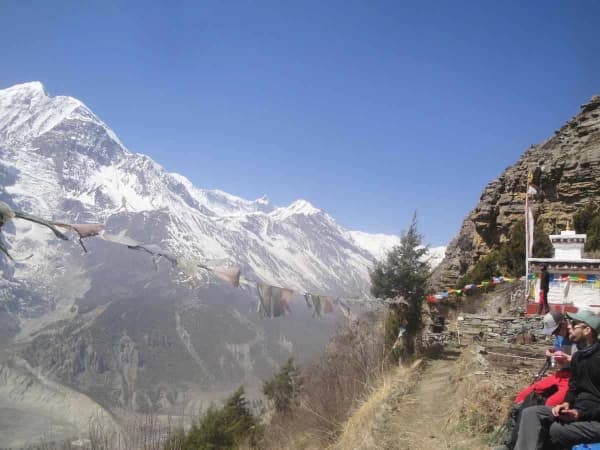
- During your Annapurna Circuit trek, enjoy waterfalls, whitewater rivers, and prayer flags fluttering in the breeze at high mountains.
- Acclimatize at Manang village and explore local lakes, monasteries, and hilltop hikes on this well-paced Annapurna Circuit itinerary.
- Cross the challenging but rewarding Thorong La Pass, the high point of the Annapurna Circuit adventure!
- Get blessed at Muktinath Temple, a holy site for Hindus and Buddhists.
- Drive along the scenic Kali Gandaki Gorge with breathtaking views of Tatopani.
- Relax your weary muscles in the natural hot springs in Tatopani.
- Hike to Ghorepani and witness the spectacular sunrise over the Himalayas from Poon Hill to end your Annapurna adventure Pass trek.
What you experience on the Annapurna Circuit Trek- 15 Days
Ready to circle one of the world's most stunning mountain ranges on the Annapurna Circuit Trek? This adventure has something new around every turn.
Explore the tenth-highest mountain and a biodiversity hotspot.
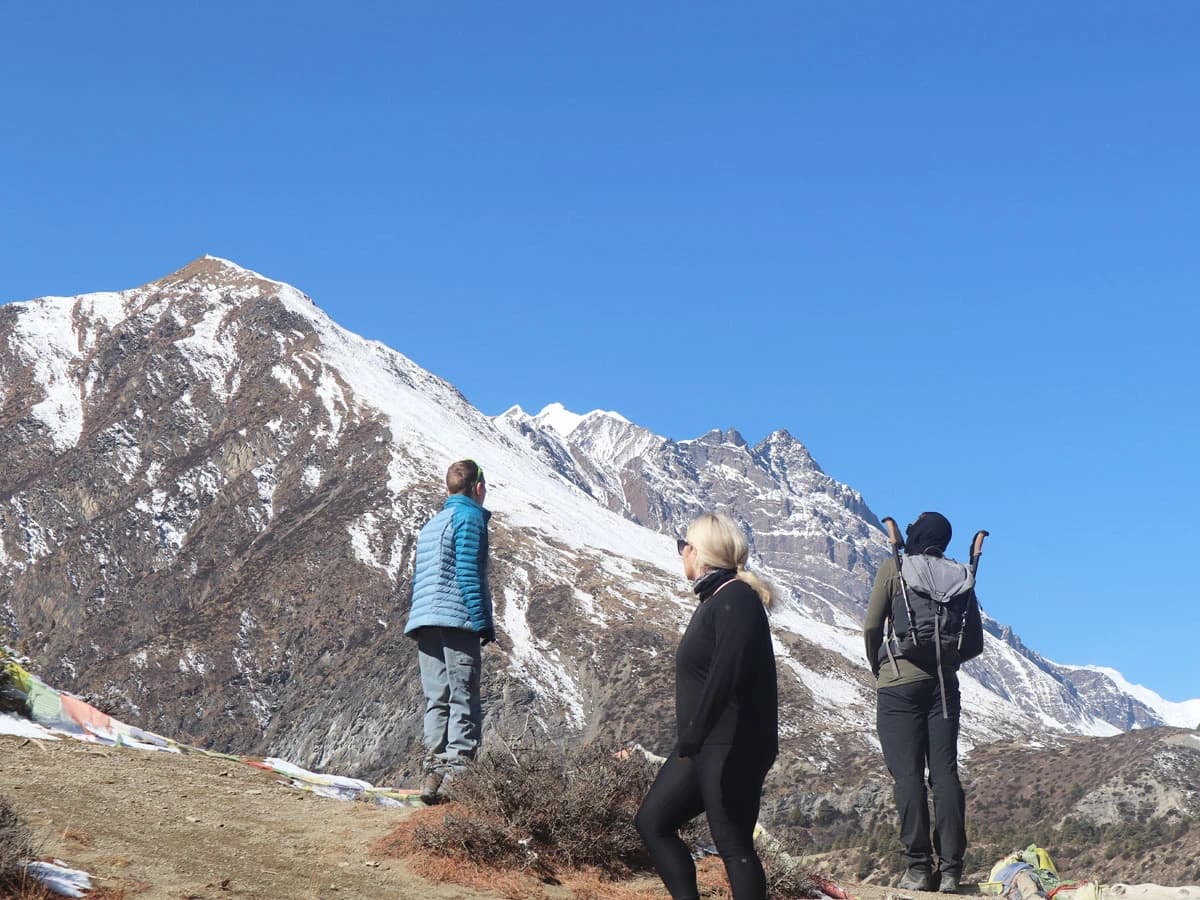
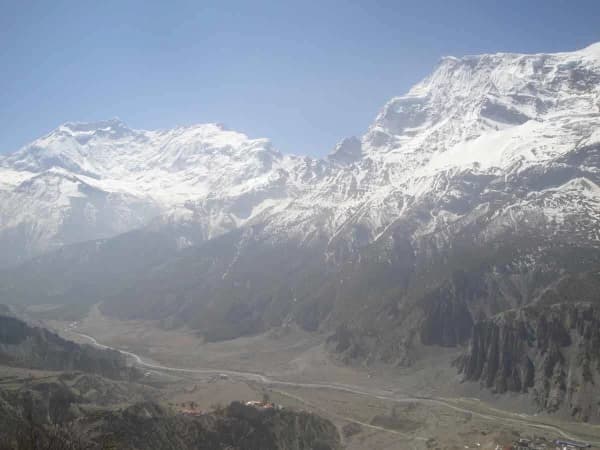
Annapurna Circuit Trek takes you far into the core of the Annapurna range, where the towering peaks of Annapurna South and Annapurna IV begin to unveil themselves on the initial days of the trek, peering out from behind hills and forests like familiar friends. As you gain altitude along the trail, the path opens up, and more Himalayan giants emerge on the horizon, providing an ever-changing vista of snow-capped beauty.
This entire experience is within the Annapurna Conservation Area, Nepal's most significant protected region. The route winds through a canopy of rhododendrons, bamboo, oak, pine, and fir, a refuge for all kinds of wildlife and birds. Don't be surprised if you get glimpses of colorful birds scurrying across the Annapurna Circuit or if you get a glimpse of shy mountain animals here and there along the way, as this trek is as much for nature as for mountains.
Follow an adventurous trekking route through the heart of the Himalayas.
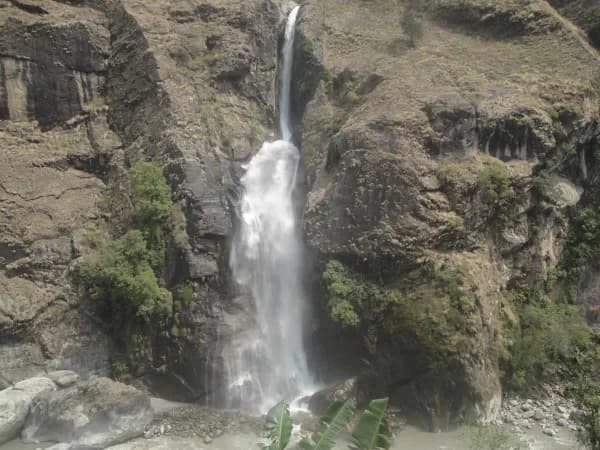
Annapurna Circuit Trekking is more than an adventure. The trail is filled with lush forests, narrow mountain trails, grassy meadows, and deep, gorgeous gorges, keeping every step different and exciting. You will walk alongside rushing rivers and see waterfalls that make you forget the sore muscles and tiredness.
With steep climbs, rocky descents, and plenty of ups and downs, this trail pushes you to your limits while immersing you in nature's serenity and pure beauty. With every challenge on the Annapurna Circuit trails comes comfort, and with every step, you are led further into the heart of the Himalayas.
Cozy villages and the friendliest faces on the trail
Annapurna Circuit takes you through several lovely villages of different ethnic communities. You come across Brahmins, Newars, and Chhetris in the lower zone. The upper trail is made up of people from the Magar, Gurung, and Thakali communities. Their warm hospitality and humble disposition will tug at your heart.
The trek is a cultural awakening that allows you to experience another side of life. Your overnight stopovers are in the villages of Bhulbhule, Chamje, Dharapani, Pisang, Manang, Yak Kharka, Thorong Phedi, Muktinath, Tatopani, and Ghorepani. You will feel welcome while sleeping with other trekkers in the lodges in these villages.
Side hikes in Manang: Acclimatize with a view
15-Day Annapurna Circuit Itinerary includes one rest day at Manang to acclimatize to the high altitude. This day also includes a rewarding side hike to keep you moving and soak up more mountain magic.
You have two great choices: hike to the historic Braga Monastery along the scenic trail, or, if you are adventurous, try the more challenging route to the stunning Ice Lake (4,500m). Either way, you will gain gradual elevation as you enjoy fabulous views while soaking up Manang's alpine scenery.
Diverse landscapes and stunning mountain panorama
Annapurna Circuit Trek is a beauty to behold, as every day brings new scenery. From lush green hills and terraced farms to rocky cliffs, alpine meadows, and barren trans-Himalayan terrain, these landscapes change dramatically with altitude.
And the mountains? They are just unforgettable; you are rewarded with a sweeping panorama of Himalayan giants such as Annapurna I (8,091m), Dhaulagiri (8,167m), Nilgiri, Tilicho Peak, Fishtail, Gangapurna, and many more. Whether you are crossing a river gorge or climbing toward a high pass, the panoramas never stop coming your way, and that is the beauty of the Annapurna Circuit trail.
Walk through lush pastures and cross Thorong La Pass.
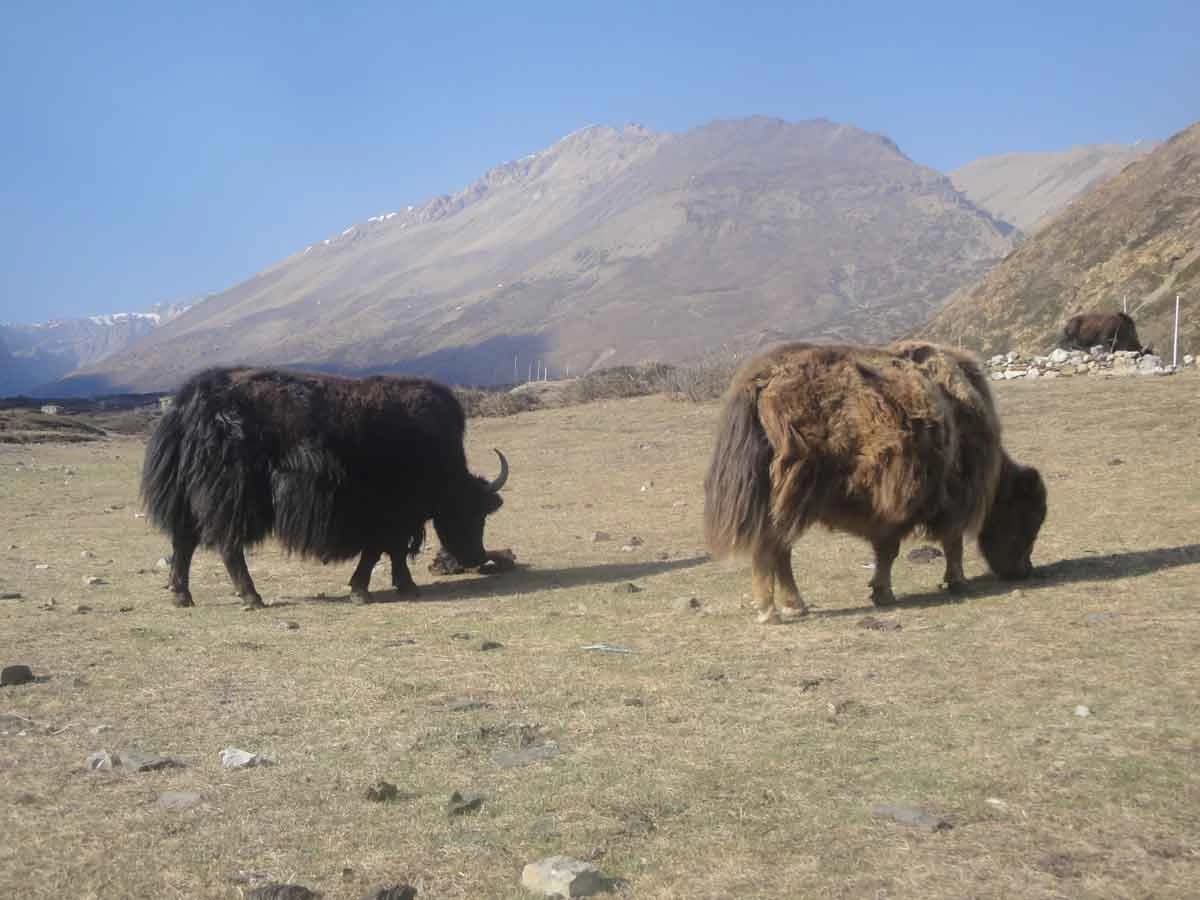
The Annapurna Circuit Trail opens up into expansive alpine meadows where you find yaks and mules peacefully grazing under the Himalayan sun.
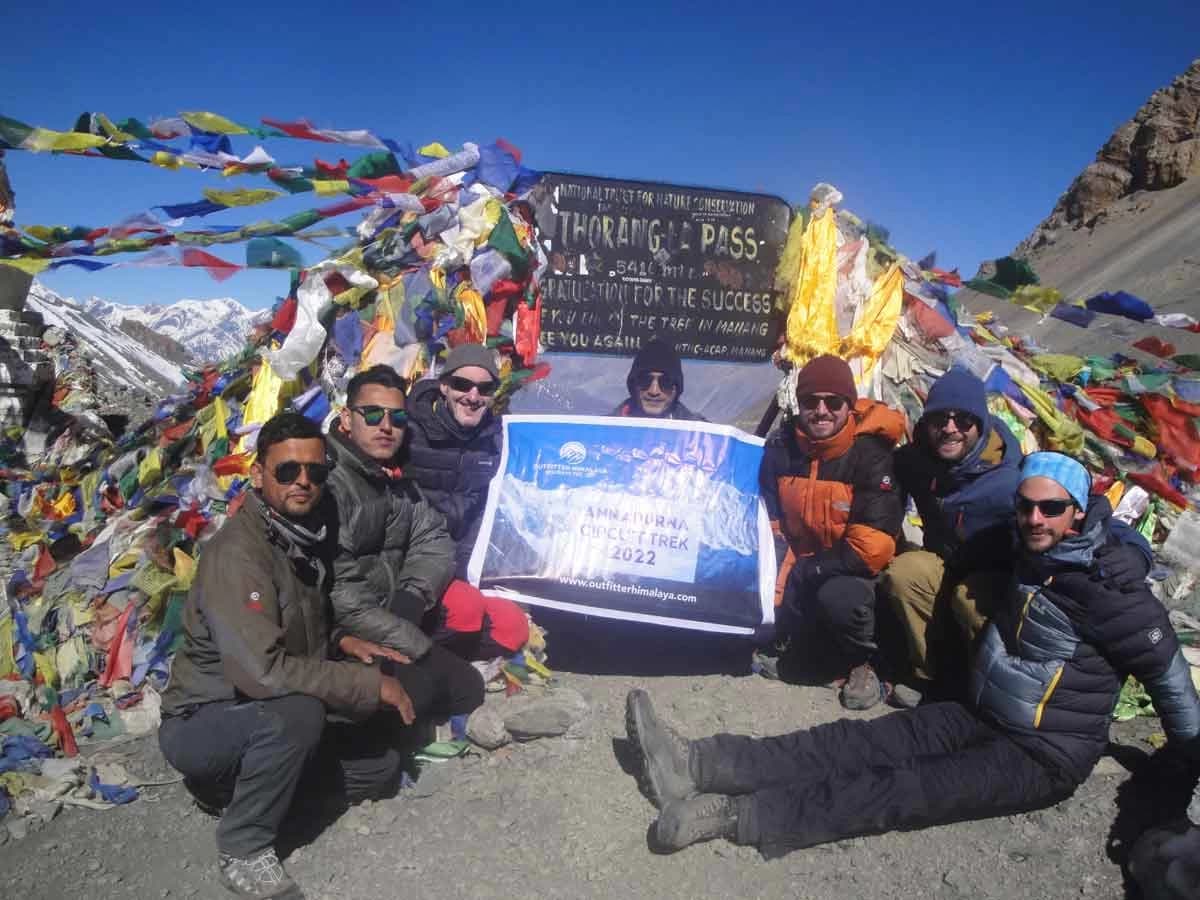
Then, the path becomes increasingly steep and rugged, leading you to the great Thorong La Pass (5,416 m), which is Nepal's highest mountain Pass and the apex of the Annapurna Circuit Trek. To cross the Thorong La Pass, you will need good stamina, proper acclimatization, and the guidance of experienced trekking staff to help you navigate the high-altitude trek conditions and terrain.
As a dreamy bonus to the already beautiful Annapurna Circuit Trek, you will stand atop Thorong La Pass and feel absolutely priceless once you conquer it.
Receive blessings at the sacred Muktinath Temple.
After crossing Thorong La Pass, the trek brings you to Muktinath Temple (3,800m), a deeply spiritual place and a religious stop on the Annapurna Circuit Route. Sacred to both Hindus and Buddhists, the 7th-century temple is among the 108 sacred Siddhpeeth. Surrounded by a peaceful mountain landscape and fluttering prayer flags, Muktinath is a serene spot to meditate, rest, and receive blessings before continuing your journey along the Kali Gandaki Valley.
Travel along the world's deepest gorge and pass by stone houses.
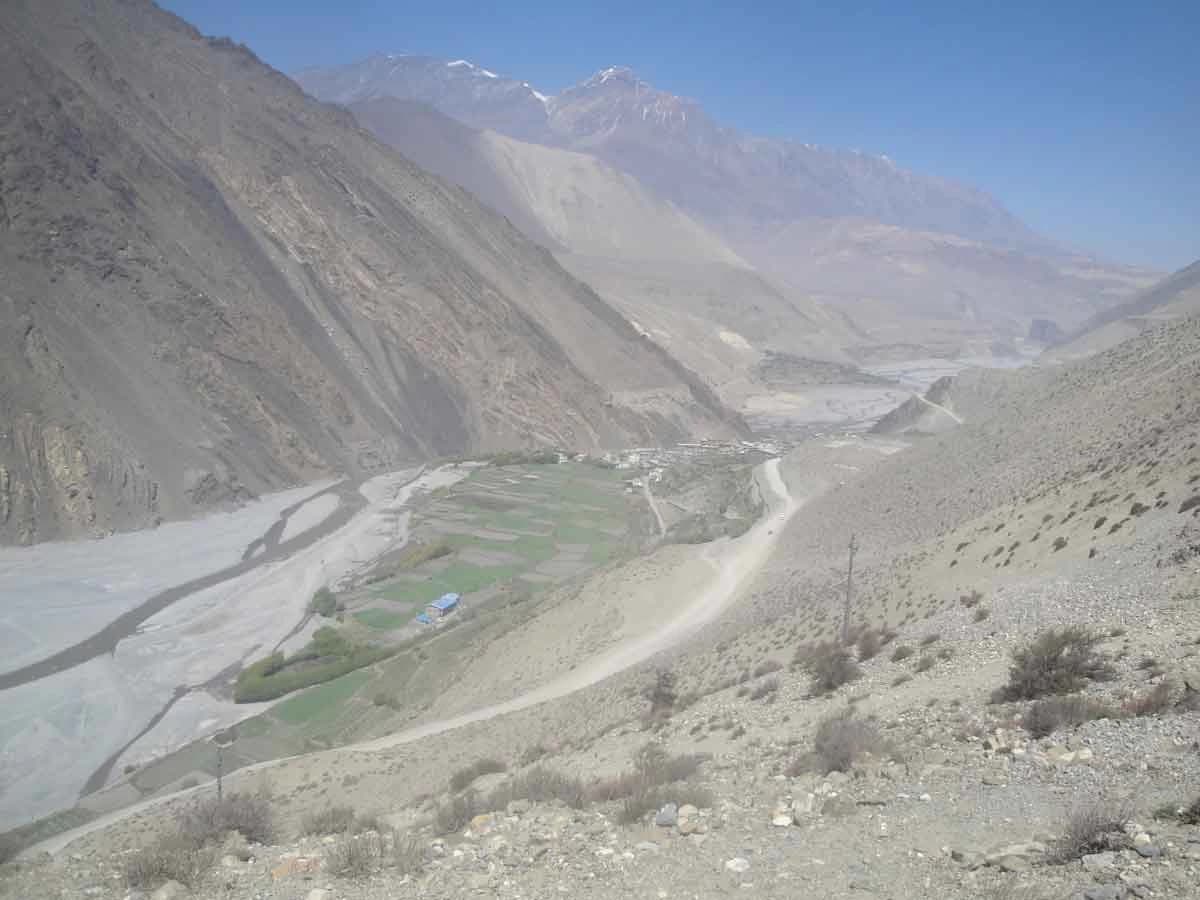
As soon as you depart from Muktinath, the Annapurna Circuit Journey continues along the Kali Gandaki Gorge, the deepest gorge in the world, formed between the Annapurna and Dhaulagiri mountains. Although less often referred to, the ancient trade route you will follow once connected Tibet, Nepal, and India.
Soak in the natural hot springs of Tatopani.
A pleasant relief after days of trekking in the Annapurna Circuit, Tatopani is a great place to unwind. Renowned for its natural hot springs, this small village offers a warm respite on the descent. The springs require a small entry fee, managed by the locals, but they're worth it.
A relaxing dip here rejuvenates fatigued muscles and is rumored to be curative for skin conditions. Be sure to wear a swimsuit and have some extra cash for this water-healing pleasure!
Catch a magical sunrise from Poon Hill.
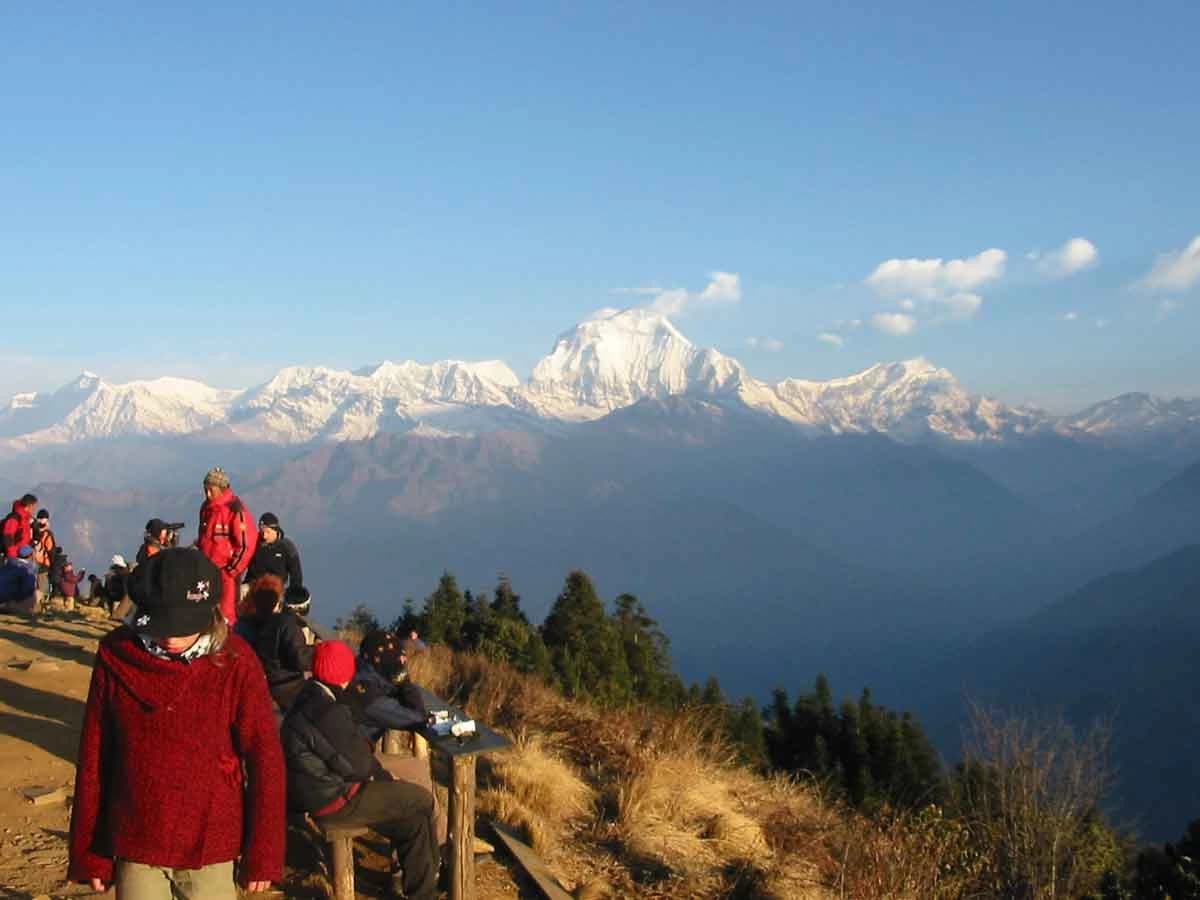
Towards the end of the Annapurna Circuit Trek, you will climb to Poon Hill (3,210m), a favorite viewpoint above the village of Ghorepani. It is an early morning walk to catch the magical panoramic sunrise lighting up the Annapurna and Dhaulagiri ranges in gold and pink hues.
Poon Hill is a highlight on its own, often undertaken as a short trek, but as part of the full Annapurna Circuit, it is the perfect finish to your Himalayas adventure in Nepal.
How High is Annapurna Circuit?
Annapurna Circuit Trek is a roller coaster of altitudes, from the green lowlands of Besisahar at just 760 meters to the stunning Thorong La Pass height of 5,416 meters!
Gradually, en route, you ascend through charming villages like Chame and Pisang, then up to 3,450 meters in Manang, where you will rest to get your breath back and acclimatize. Then, up and away to Yak Kharka and ThorongPhedi, your gateway to passing through Nepal's renowned highest mountain pass. After the arduous ascent, you descend to the sacred village of Muktinath at 3,800 meters, then down again to the warm valley of Tatopani (1,190 meters) - yes, that's nearly 4,300 meters of elevation gain!
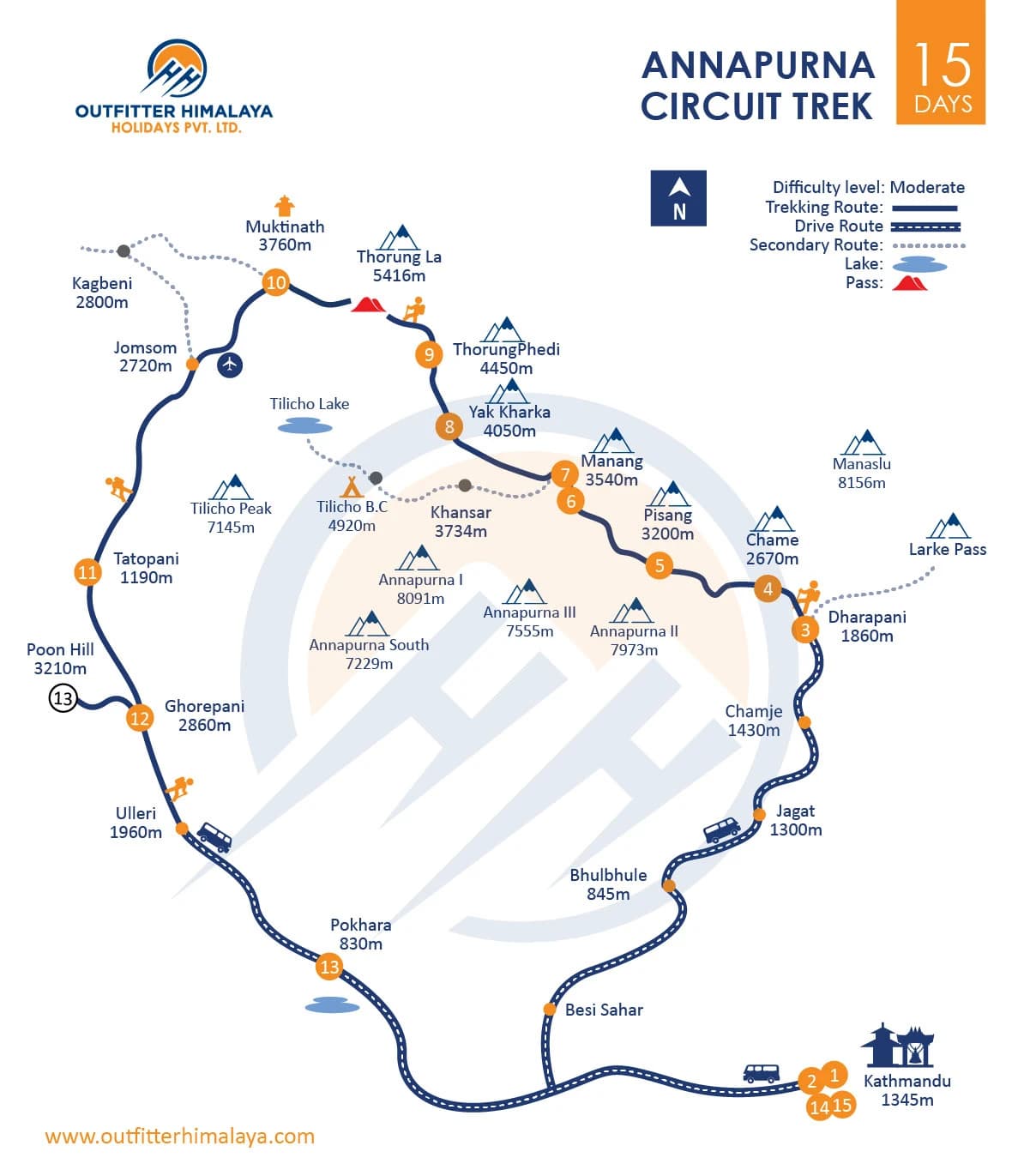
The hike ends with a forest climb to Ghorepani (2,860m) and a magical sunrise at Poon Hill (3,210m). With each shift in elevation, the landscape, culture, and adventure shift - each step along the Annapurna Circuit is a new world. Look at the attached Annapurna Circuit Trekking route map to learn about daily altitude gain.
How long is the Annapurna Circuit Trek?
In our 15-day Annapurna Circuit Trek Itinerary, you will cover around 116 kilometers on foot, starting from Dharapani (1,960m) and ending at Ulleri (2,070m). Along the way, you will pass through beautiful villages like Chame, Pisang, and Manang before reaching the iconic Thorong La Pass at 5,416m,the highest point of the adventure. Look at the detailed Itinerary section for daily walking distance.
How Difficult is the Annapurna Circuit Trek?
Trekking Annapurna Circuit is no small task, and the highlight of the adventure is crossing the intimidating Thorong La Pass at an astounding 5416 m. It is the biggest trekking pass in Nepal and one of the most memorable parts of the journey.
While you will not encounter any serious technical challenges in the Annapurna Circuit, it does demand good planning, preparation, physical fitness, and mental strength. You will spend nearly ten days in the heart of the Himalayas, adjusting to a more basic way of life, with basic but comfortable teahouses, hearty mountain meals, and breathtaking views in every direction.
The terrain at higher elevations can be demanding, with steep climbs, rocky paths, and seemingly endless stone staircases. The farther you go into the mountains, the more remote the trail gets and the fewer amenities there will be.
Annapurna Circuit Trek Route Map
The 15-day Annapurna Circuit Trek will start in Dharapani and lead you through Chame, Pisang, and Manang before crossing the famous Thorong La Pass at 5,416m. The trek then moves down towards the holy site of Muktinath, from which it traverses pathways to Tatopani and Ghorepani, with an ascent to Poon Hill for sunrise.
Along the trails, you can find diverse terrains, pretty villages, and breathtaking views of the Himalayas. Check our route map on the page for more details.
Annapurna Circuit Trek Cost for 2026 and 2027
We have opened bookings for 2026 and 2027 and have fixed the cost for the 15-day Annapurna Circuit Trek. The price depends on the number of trekkers you are booking for; find the details.
| Number of Trekkers | Cost Per Person |
| 1 Pax | US $1250.00 |
| 2 - 5 Pax | US $1100.00 |
| 6 and above | US $1000.00 |
Why Book the Annapurna Circuit Trek with Outfitter Himalaya
- Local experts with years of experience organizing the Annapurna Circuit
- Carefully designed itineraries with proper acclimatization
- Experienced, licensed guides who know the trail and current conditions
- Reliable teahouse arrangements even in busy seasons
- All necessary permits handled for you
- Flexible and personalized service for private and small group departures
- Strong focus on safety, responsible tourism, and genuine local hospitality
- Transparent pricing with no hidden costs
- 24/7 support from our Kathmandu office before, during, and after your trek
- High client satisfaction and many repeat travelers
When you book with Outfitter Himalaya, you trek with a team that truly knows the Annapurna region and is committed to making your journey safe, smooth, and memorable.
- Day 01: Arrival at Kathmandu airport and transfer to hotel
- Day 02: Kathmandu cultural exploration and checklist day
- Day 03: Drive from Kathmandu to Dharapani
- Day 04: Trek from Dharapani to Chame
- Day 05: Trek from Chame to Pisang
- Day 06: Trek from Pisang to Manang
- Day 07: A rest day at Manang for acclimatization
- Day 08: Trek from Manang to Yak kharka
- Day 09: Trek from Yak Kharka to Thorong Phedi/High Camp
- Day 10: Trek from Thorong Phedi to Muktinath via Thorong La pass
- Day 11: Drive from Muktinath to Tatopani
- Day 12: Trek from Tatopani to Ghorepani
- Day 13: Hike to Poon Hill and trek down to Ulleri and drive to Pokhara
- Day 14: Drive from Pokhara to Kathmandu
- Day 15: Transfer to the international airport for your departure flight


Find the detailed itinerary for the 15-Day Annapurna Circuit Trek. The itinerary is a standard itinerary that we offer you; however, it is customizable. Inquire with us if the offered program is not suitable for you and you want to trek on your own itinerary.
Touch down in Kathmandu!
Our friendly team will be ready to welcome you at the terminal gate and whisk you off to your hotel in Kathmandu. After settling in, you can nap off your jet lag, unpack, stroll nearby streets, or just gaze at your new surroundings.
After breakfast, we will explore the city's cultural gems - Boudhnath, Swayambhunath (Monkey Temple), Pashupatinath, and the buzzing Durbar Square.
We will return to the hotel by late afternoon to pack up, meet your trekking crew, and get pumped for the trail ahead!
We have a long journey to the starting point of the trek today. After having a warm breakfast, we leave Kathmandu and drive following green hills, rivers, and terraces. The drive will be smooth for the most part.
Passing by Besisahar, we'll continue the drive to Dharapani, enjoying the view peaks.
Your Annapurna Circuit Himalayan story is about to begin!
It is a long day ahead, so we start early and energized. The trail goes through pretty rural villages and subtropical forests, and we can see some unique rock formations along the way with a great mountain panorama.
After about two hours, we reach Timang, follow the Marshyangdi River, pass Koto, and finally reach Chame, the district headquarters, and a scenic stop at 2,670 meters.
This trail section is beautiful. We walk through massive apple orchards and see Paungda Danda, a huge rock that rises 1,500 meters above a river.
Here, we walk past prayer wheels and dense pine forest and do another four-hour trek through the green hills before we reach Pisang village.
Today, we hike the upper trail via Ghyaru. This is a very scenic trail. Along this part of the trail and onward, you can sense the Tibetan Buddhist influence. Traveling through thick forests and Mani walls, we reach Ngawal.
Then, we proceeded up and trekked through a forest to Braga. After that, we walked up to quaint Manang village.
We take a rest day in Manang village to acclimatize to high altitude and avoid developing altitude sickness. We make the most of our day and explore nearby hiking options to Praken Gompa, Gangapurna Lake, or Ice Lake (4,500m).
After returning from the hike, we will spend the remaining day in Manang village. Manang village is full of life, with coffee shops, museums, and a theatre, so we will fully enjoy our stay.
There’s something about this stretch that feels grounding. Manang slips behind us, and we walk into soft hills covered in alpine grasses amidst quiet thoughts. Gunsang greets us with an embrace of cold air and a promise of even more.
We will see horses grazing in the meadow while the yaks roam peacefully.
The firs and junipers gently guide us uphill to Yak Kharka, a calm and pleasant natural haven.
It is a short walk today, yet one brimming with expectations. We begin our climb along the steady upward track toward Ledar, passing the familiar Deurali Tea House and following the trail beside the Jarang Khola.
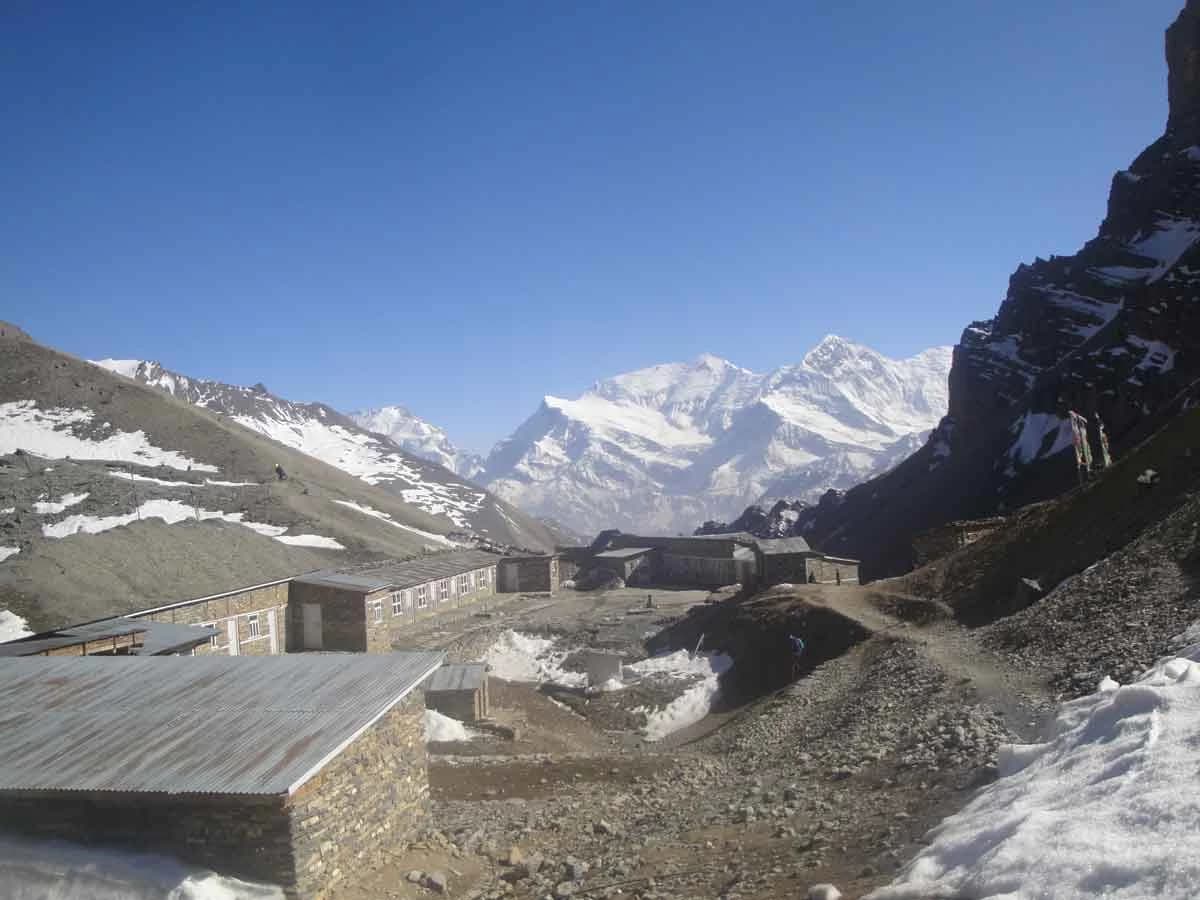
From here onwards, the road becomes a bit rugged on the way to Thorong Phedi, our base for the big climb. If time and energy permit, we will push a little further up to High Camp so that crossing Thorong La Pass tomorrow morning will be a bit easier.
As we continue our ascent into a large alpine landscape, the landscape opens dramatically into a vast alpine world.
Tonight, we sleep soundly as an early dawn start is ahead, and so is one of Nepal's highest trekking passes.
We rise early today and prepare to undertake one of the most beautiful sections of the Annapurna Circuit trek. Departing from either Thorong Phedi or High Camp, we begin the long journey ascending to Thorong La Pass, the journey's highest point.
The route winds past a small transit shelter, gaining elevation with every step. Above, we are greeted with fluttering prayer flags and some of the highest views of snow-clad Himalayas.
We take in miraculous views from the top and move gently downwards to the holy village of Muktinath, where we can find some rest and comfort.
Before leaving Muktinath, we will visit the holy temple and seek blessings for the journey ahead. While non-Hindus are not allowed into the inner sanctum, there is still plenty to see around the temple complex, from the old shrines to the holy 108 water spouts.
After breakfast, we will ride a jeep or a local bus for a bumpy ride toward Tatopani.
The drive is scenic, as it follows the gorge of Kali Gandaki, past hillside villages, terraced fields, and an endless array of snowy peaks in the serene Annapurna Circuit trek.
We will start with a relaxing walk on a flat trail and then ascend steeply on a pathway through quiet villages and terraced fields rising to the hillsides. The path takes us into a green forest, guiding us by the hamlets of Phalate and Chitre.
As we proceed, the final section winds through a rhododendron forest before we eventually arrive in the charming village of Ghorepani.
This is an absolutely beautiful place to spend the night at the end of the trek through the Annapurna Circuit.
We step out at dawn into the chilly morning before the world wakes up and start our climb to Poon Hill with flashlights dancing on the trail, breath visible in the crisp mountain air. As the first light breaks over the horizon, a stunning panorama of Mount Dhaulagiri, Annapurna, Tukuche, Nilgiri, Fishtail (Machhapuchhre), Gangapurna, Hiunchuli, LamjungHimal, and others come into view with soft hues of gold and pink.
After a while, we return to the teahouse to have breakfast. With hearts (and cameras) complete, we descend through rhododendron and oak forests, heading to Ulleri.
Following a subdued lunch, we board a vehicle and return to Pokhara as a soft ending to our Annapurna Circuit adventure.
We will travel by highway from Pokhara to Kathmandu, passing through the hills and river beside us. It will be a smooth drive and a perfect time to reflect on the trip.
When we arrive, we will drop you off at your hotel, and you can relax or explore the city as you wish.
In the evening, we will be together as a group for a cozy farewell dinner with the team one last time, reliving memories, our wins, and the magical Annapurna Circuit trek.
One last Namaste!
Pack up your bags, those memories, and maybe some souvenirs - it is time to catch your flight home.
Our assigned team will drive you to Tribhuvan International Airport and send you off with big smiles and hugs!
Accommodation and Meals
- 3 nights’ accommodation in Kathmandu in 3 star hotels (Twin/double share)
- 1 nights’ accommodation in Pokhara in 2-3 star hotels (Twin/double share)
- 9 nights’ accommodation in Annapurna Base Camp trail on twin share/Dormitory Share
- A total of 35 (14 breakfasts, 11 lunches, and11 dinners- as per the above itinerary) meals.
Transfers, Transportation and tours
- All (international and domestic) airport transfers on a tourist vehicle
- Kathmandu tour on a private tourist vehicle
- Ground transportation from Kathmandu – Dharapani, Muktinath to Tatopani and and Pokhara - Kathmandu by local bus/jeep/tourist bus
Trekking Guide and crew
- An experienced, government licensed and an assistance guide when there are 9 or more people in the group.
- Trekking porter- a Porter for 2 people and a porter carry about 20-22 KG.
- Wages, accommodation, meals, gear, insurance and medications for guide and porters
Trekking Permits and fees
- Annapurna circuit Trek Permit
- TIMS Permit
Extra Services
- Arrangement of emergency helicopter service (which will be paid for by the travel insurance company)
- Sleeping bag, down jackets, and duffel bag, if necessary (returned after the trek)
- Seasonal fruits after dinner while on the trek
- Annapurna circuit trekking route map
- First Aid and oximeter
Service charge and fees
- All administrative expenses
- Government taxes
- Nepal entry visa fee
- Travel insurance (compulsory)
- Meals (Lunch and Dinner) while you are in Kathmandu and Pokhara
- Entrance fee on sightseeing tour in Kathmandu (Day-2) about NPR- 2600.00 Per person
- Your personnel expenses/shopping
- All the alcoholic and non-alcoholic drinks, drink water, chocolate bars and bar bills
- Hot shower, internet, telephone, and laundry
- International airfare to and from Nepal
- Tips for the guide and staff
- Anything not mentioned in the included section
Transports Upgrade
- Upgrade Transport to Private Jeep (On Day 3): There are options to upgrade the transport to a private jeep instead of the local bus. A Jeep costs US $290.00, and 6 people can drive in a Jeep.
- Upgrade to flight from Pokhara to Kathmandu: On Day 14, you can take a flight from Pokhara to Kathmandu instead of a long bus journey, which costs US $125.00 per person.
Annapurna Circuit Trek Options: How would you like to experience the Annapurna Circuit Trek with Outfitter Himalaya?
- Are you Solo traveller and Joining a Group Trek and want to have private room: Solo traveller will be paired with another traveller when you are solo and join the group trek. We guarantee a single room in Kathmandu and Pokhara (4 nights) and most of the accommodations during the trek. Please select this option if you want this option.
- Small Group Trek to Annapurna Circuit Trek:We have fixed dates for 2026 and 2027 to join the Small Group Annapurna Circuit Trek. The group size will range from 1 to 12 pax. Please select a date and book on your preferred date.
- Solo Private Annapurna Circuit Trek: We organize a solo private trek to Annapurna Circuit, available on any date of the year. You can choose any date from the fixed dates or check availability if the given date is not suitable for you. There will be additional Costs applies to do a Solo Trek. Please select the Solo Private Trek option at checkout if you prefer this option.
- Private Annapurna Circuit Trek: If you are two or more and want to do a private trek to Annapurna Circuit Trek, An Additional fee applies. Please tick to make it private at checkout time, or check availability. This type of tour is available on any date of the year.
Are the dates offered unsuitable, or do you want to take a private trip? Check availability for your date.
What does our local guide Saroj suggest for successfully crossing the Thorong La Pass?
Hi, I am Saroj, and I have crossed Thorong La Pass more than 15 times across all seasons (Autumn, Winter, Spring, and Monsoon). I want to suggest the following to make your Annapurna Circuit Successful.
- Master Your Acclimatization: Spend at least two nights in Manang (3,540m) before crossing the Thorong La and take an acclimatization day hike up to Ice Lake or Gangapurna Lake to "climb high, sleep low."
- Start Early (4:00 AM – 5:00 AM): The Thorong La Pass summit experiences strong winds after midday, so I suggest leaving Thorong Phedi or High Camp early to ensure you reach the pass around 9:00–10:00 AM before severe weather rolls in.
- Pace Your Breath, Not Your Clock: Please walk slowly, acclimatize well before the pass, and if you feel a mild headache, take Diamox (Acetazolamide) and drink 4+ liters of water daily. If severe symptoms hit (confusion, persistent vomiting, loss of coordination), turn around immediately.
- Gear Up for Sub-Zero Conditions: Wind-proof outerwear, heavy thermal base layers, microspikes or crampons for icy stretches, and insulated gloves are mandatory. Temperatures at the pass regularly drop below -15°C (5°F) with wind chill before sunrise.
- Plan the Long Descent: The ascent to Thorong La is hard, but the 1,600m downhill drop to Muktinath is brutal on the knees. Bring sturdy trekking poles with snow baskets and knee supports.
What Other Treks Does Outfitter Himalaya Offer in Annapurna With Thorong La Pass?
Outfitter Himalaya offers many Annapurna Circuit Treks, and you can choose whichever suits you best..
- Short Annapurna Circuit Trek – 9 Days: Go on this short 9-day Annapurna Circuit Trek if you are short on time and want to arrange your own accommodation in Kathmandu and Pokhara and want to book the trek only.
- Annapurna Circuit With Tilicho Lake Trek: Book Annapurna Circuit With Tilicho Lake if you want to add the side trip to Tilicho Lake on the Annapurna Circuit Itinerary.
- Annapurna Circuit Trek from Pokhara: Book the Annapurna Circuit Trek from Pokhara if you are already in Pokhara or want to start the trek from Pokhara instead of Kathmandu.
- Nar Phu and Annapurna Circuit Trek: Book this package if you want to explore the 2 treks in one single holiday- the Nar Phu and Thorong La.
- Annapurna Circuit plus ABC: Book this Trek if you are looking for a long mountain holiday in Nepal and want to explore both treks- the Annapurna Circuit and Base Camp.
- Annapurna Circuit Trek in Comfort: Book this comfort trek if you are looking to experience the Annapurna Circuit at your own pace and stay in the most comfortable available tea houses along the trail.
Best Time for Annapurna Circuit Trek
The best time for the Annapurna Circuit Trek is during the two main trekking seasons in Nepal: Autumn (September, October, and November) and Spring (March, April, and May).
Autumn is widely considered the finest overall season. After the Monsoon clears, the skies become exceptionally clear, the trails are dry, and mountain views of the Annapurna and Dhaulagiri ranges are at their sharpest. October is the single best month for most trekkers because of stable weather and excellent visibility. November remains excellent, with slightly fewer crowds and colder nights. Learn more about the Annapurna Circuit Trek every month of Autumn.
- Annapurna Circuit Trek in September
- Annapurna Circuit Trek in October
- Annapurna Circuit Trek in November
Spring offers milder temperatures and beautiful rhododendron blooms, especially in March and April. The weather is stable, and the high pass (Thorong La) is usually in good condition. Late March to mid-May is ideal if you prefer warmer days and colorful landscapes.
Read our comprehensive blog regarding the Annapurna Circuit trek in different months of Spring.
- Annapurna Circuit Trek in March
- Annapurna Circuit Trek in April
- Annapurna Circuit Trek in May
The trek is also possible during winter and Monsoon, but these seasons require more preparation. Winter is possible for trekkers; the trails are quiet, and the views can be outstanding. Still, temperatures drop significantly above Manang, and Thorong La can become challenging due to snow and extreme cold.
Read our monthly guide for the winter trek to the Annapurna Circuit.
- Annapurna Circuit Trek in December
- Annapurna Circuit Trek in January
- Annapurna Circuit Trek in February
The Monsoon (June-August) is generally not recommended due to heavy rain, muddy trails, leeches in the lower sections, and limited mountain views. However, it is not impossible for experienced trekkers with extra preparation. Read our comprehensive blog to know more about the Annapurna Circuit trail in different months of the monsoon.
Foods and Drinks available on Annapurna Circuit Trek - 15 Days
A total of 35 meals (14 breakfasts, 11 lunches, and 11 dinners) are included in our 15-Day Annapurna Circuit Package. You will find a good selection of meals throughout most of the Annapurna Circuit. Teahouses along the Annapurna Circuit serve simple, filling meals that mix Nepali, Tibetan, and basic Western dishes.
The most common and reliable option is Dal Bhat (rice, lentil soup, and vegetables) – the most popular and best-value meal, often with free refills, along with fried rice, noodles, pasta, momos, Tibetan bread, porridge, eggs, and soups. As you go higher up, the menu becomes shorter, and prices increase, but the food remains nourishing.
Hot drinks such as tea, coffee, ginger lemon tea, and hot chocolate are widely available. Soft drinks and occasional fresh juices are available in lower villages. We strongly recommend using boiled or treated water rather than relying on untreated natural water sources, and avoiding alcohol until after crossing Thorong La Pass. Eating regular meals and staying hydrated are among the simplest ways to support acclimatization.
Accommodation on Annapurna Circuit Trek - 15 Days
A total of 14 nights of accommodation are covered in the cost of the Annapurna Circuit. You will stay at a local 3-star hotel for 3 nights in Kathmandu (2 nights pre-trek and 1 night post-trek) and 1 night in Pokhara after the trek, and the remaining 10 nights are in the teahouses available along the trail.
The accommodation on the Annapurna Circuit Trek is based on the traditional teahouse system. They are mainly offered in simple, family-run mountain lodges and local teahouses that provide beds, blankets, and meals. These are simple but comfortable accommodations that allow you to experience the hospitality and lifestyle of the Himalayan communities along the route.
What to expect:
- Twin-sharing rooms with basic mattresses and pillows
- Shared or (in some places) attached bathrooms
- Dining halls are often the warmest part of the lodge
- Hot showers available in many places (usually for an extra fee)
- Charging facilities for phones and cameras (small fee common at higher elevations)
Rooms are generally clean and comfortable enough for trekkers, though they are not heated. Higher up (especially around Manang, Yak Kharka, and ThorongPhedi), facilities become more basic, and rooms can feel colder at night.
In peak season, better lodges fill up quickly, so booking through a reliable operator helps secure good rooms. Overall, the teahouse experience is one of the most enjoyable parts of the trek — simple, friendly, and full of local character.
Annapurna Circuit Trek weather and temperature
The weather in the Annapurna Circuit Trail changes dramatically with altitude and season. The trek starts in warm, subtropical valleys and climbs into high-alpine and cold, desert-like conditions around Thorong La Pass (5,416m). The daytime temperatures range from 10-25℃ in lower areas and 0-10℃ at higher elevations, with nights often below freezing above 3,500 m.
Autumn and spring generally offer the most stable and comfortable conditions, and Winter is much colder, with possible snow at high elevations. At the same time, the monsoon brings rain and limited views. Read a blog about season-wise weather and a temperature guide along the Annapurna Circuit Trail.
Altitude sickness on Annapurna Circuit Trek
As you travel up into the mountains, some people may feel altitude sickness or AMS (Acute Mountain Sickness). But don't stress! Our 15-day Annapurna Circuit itinerary is designed with plenty of acclimatization time and a safety-first approach from start to finish.
That said, altitude can be unpredictable. Even with all the proper preparation, some people might still feel the effects. If that happens, your guide will be right there to help- trained to spot symptoms early, provide first aid, and ensure you are taken care of.
The Annapurna Circuit trek is absolutely safe and will be a remarkable journey as long as you are kind to your body, do not push beyond your limits, and follow your guide’s lead.
Annapurna Circuit Trek Preparation: How to prepare for the Annapurna Circuit Trek?
Getting trek-ready for the Annapurna Circuit before hitting the trails includes wise body conditioning for the challenge. We suggest you build your endurance, enhance your stamina, and strengthen your core through regular cardio, strength training, and long walks, better yet, with a backpack filled to about 5 kg.
You can also try cycling, swimming, hiking, and jogging. A regular gym routine is also beneficial. And, of course, don’t forget to visit the doctor and review your gear with our packing list before you go!
Annapurna Circuit Trek Guides and Porters
Trekking Guide and porter are included in our Annapurna Circuit 15-day package Cost.
An officially certified guide contributes cultural awareness, map reading, and an extra layer of security on the journey, especially at heights like Thorong La Pass. Similarly, porters carry heavy backpacks or bags for you and leave you free to enjoy breathtaking views along the trek.
Annapurna Circuit Trek Equipment List
Key trekking gear for the Annapurna Circuit trek includes a warm sleeping bag, layered clothing (base layers, fleece, down jacket), good hiking boots, trekking poles, a backpack, and a rain jacket. Don't forget to bring sunglasses, sunscreen, a hat, water purification tablets, and a refillable water bottle. Other useful items are your headlamp, quick-dry towel, and small first-aid kit.
Missing something? No problem, there are enough stores in Pokhara and Kathmandu where you can rent or buy trekking equipment. We will also provide you with an exhaustive packing list before the trek! Read our Packing list blog for more ideas.
Yes, it is crucial for you to have Travel Insurance for the Annapurna Circuit Trek. Since it is a high-altitude trek, there are obvious possible risks involved. We will provide transportation to the nearest medical facility if you suffer sickness or injury during the trek. However, you will be liable for all associated costs, including evacuation.
Most importantly, you will need to verify that your insurance policy covers high-altitude trekking and includes arrangements for emergency rescues.
Certainly! You can join one of our group treks for the Annapurna Circuit even if you are a solo trekker. These fixed-departure group adventures are open to all and are relaxed and friendly.
If you talk about the size, the groups may consist of 1-12 people, providing you with a comfortable and social trekking experience!
Tilicho Lake can be added to your Annapurna Circuit trek, but it will require an additional three days.
If you are interested, we offer an alternate itinerary that includes this beautiful high-altitude lake in the Annapurna Circuit schedule. Just let us know your preference, and we will make arrangements for you to visit Heavenly Tilicho Lake.
Yes, you can extend your trek to Annapurna Base Camp from Ghorepani (Poon Hill). We also offer a combined itinerary that includes the Annapurna Circuit and Annapurna Base Camp.
This extended route offers variety and allows trekkers to experience a wider range of landscapes. It is a great way to make the most of your time in the Himalayas. It is ideal for those who want a comprehensive trekking experience in the Annapurna region.
You can get hot water for showers at most teahouses until Manang for between USD 3 and USD 5. Beyond Manang, you will be trekking at higher elevations where temperatures drop significantly. While there may be hot water available, we don’t recommend trying to shower, as you might catch a cold or otherwise weaken your body.
Instead, we suggest waiting until you return to a lower altitude site like Muktinath or Jomsom to shower. When showering is not an option, you can always use wet tissues and dry shampoo to keep things fresh!
Annapurna Circuit has charging available at many points along the route, often for a small fee, usually USD 1 to 2 per device.
As you trek higher, electricity is often limited and powered by solar, meaning charging can be slow or busy. For peace of mind, we recommend bringing a high-capacity power bank, spare camera batteries, or a portable solar charger. Being well prepared means your devices should stay charged for emergencies or for the views of a lifetime.
While trekking the Annapurna Circuit, you can access Wi-Fi for a small fee in most teahouses up to Manang. However, after Manang and northwards, both Wi-Fi and mobile signals grow increasingly unreliable. If the weather is unfavorable from Yak Kharka to Muktinath, communication can be lost altogether.
We recommend downloading maps, music, and required apps in advance, and informing loved ones of possible communication gaps.
Annapurna Circuit is definitely not an ordinary trek. Still, beginners can totally rock it with a bit of cardio preparation, a good attitude, and timely breaks to sip ginger tea and spot yaks.
Remember: this trek is less about the number of hours and kilometers and more about having fun. You are already halfway there if you can walk, laugh, and appreciate a good mountain view!
Hiking in the Annapurna Circuit is safe with good preparation, sound acclimatization, and a dash of self-awareness. The trails are well-marked, and the teahouses are hospitable and cozy. But yes, altitude is real, so we take it slow and steady.
It is an adventure with a safety net and delicious DaalBhaat! A local guide could be your savior, especially if you are new to high-altitude trekking. And remember- no summit selfie is worth skipping water breaks and rest days!
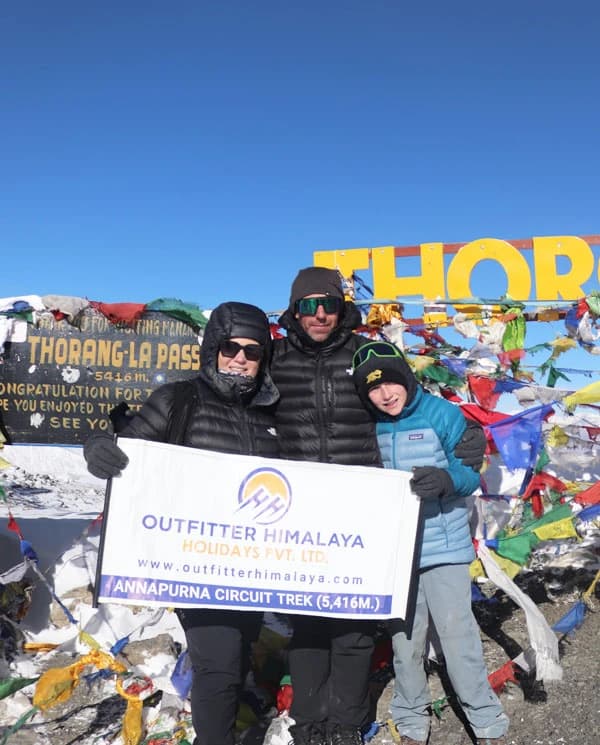
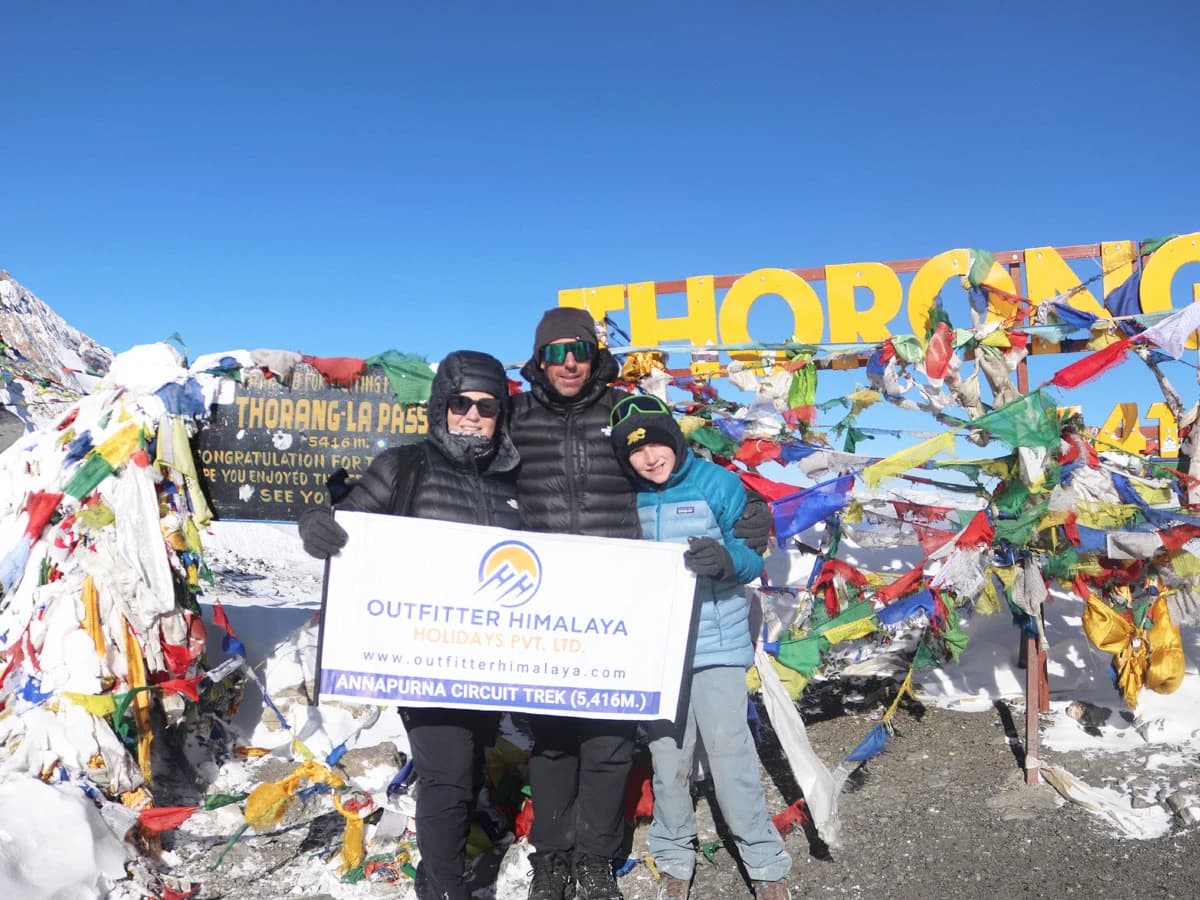
The iconic Thorong La Pass, at 5,416 meters (17,769 feet) above sea level, is the pinnacle of the Annapurna Circuit journey.This spectacle is the literal highest point on this trek.
Reaching the summit takes tremendous effort, but standing on top is surreal. With the magical landscape, fluttering prayer flags, and snow-covered peaks, every step to the top is a story worth telling.
Annapurna Circuit Trek has high passes, long trails, and unpredictable weather, but nothing that a passionate trekker can't handle. It is possible if you've got good fitness levels, take time to acclimatize, and are mentally prepared to give the trek a go.
The absolute pleasure of the trek is pushing your limits and knowing how strong and determined you are! Plus, the incredible views of Annapurna region make the sore legs and early morning wakings totally worth it!
Annapurna Circuit trail is located in the western Himalayan range in Nepal. The trek starts from Dharapani, hikes to Manang, crosses the Thorong La Pass, and descends to Ghorepani village and end at Pokhara.
Our Annapurna Circuit trek is 12 days long. The trip starts and ends in Kathmandu.
No, the Annapurna Circuit trek is not suitable for beginners. Even if you are physically fit, the trek further demands patience, a good understanding of Himalayan terrain and limitations, and previous high-altitude exposure.
The best time to do the Annapurna Circuit is March, April, May, late September, October, November, and mid-December. Annapurna circuit trekking between late February and early March and late November and early December to avoid crowds.
Our Annapurna Circuit trek package includes a guide. So, if you buy our package, you will get the service. Trekking with a guide is always better than trekking alone.
You will be safe, not get lost, and learn a lot about the locals and the region. Guides add more value to your journey than just being a map.
Annapurna Circuit is challenging and recommended to trekkers who have previous hiking experience and are in good shape. It is an offbeat trek with many steep sections and also crosses the highest mountain pass in Nepal.
The drive from Kathmandu to Dharapani is around 8 to 9 hours long. First, you will drive to Besisahar and change the vehicle here. From Besisahar, you will follow rugged cliff sides and slowly drive to Dharapani.
Yes, you can customize the Annapurna Circuit trek itinerary. We can customize the itinerary and services included in the package to fit your requirements and budget. You can also add other destinations, like Tilicho Lake, Annapurna Base Camp, Ghandruk Village, etc, to your itinerary.
You must be physically and mentally strong to do the Annapurna Circuit trekking. It is a challenging trek that requires an average 6 to 7 hours of walking on rugged terrain while gaining altitude each day. Therefore, trekkers have to be fit. Previous trekking experience is also important.
There are no age restrictions for Annapurna Circuit trekking. Under-age trekkers (below 18 years old) must be accompanied by an identified guardian.
Annapurna Circuit hike has many challenges. The terrain is offbeat and steep in many sections and involves several sharp ascents and descents.
Likewise, the facilities on the Annapurna Circuit route are also basic, so we recommend parents properly assess their kid's physical and mental health before including them in your Annapurna Circuit trek.
There are no hidden costs during the Annapurna Circuit trek, but you have to understand what our package includes and what not to budget the uncovered expenses.
The package cost does not include things like trekking porter, shopping, tips, international flights to/from Nepal, travel insurance, etc. Likewise, it does not cover charging, WiFi, and hot shower expenses during the trek.
Yes, you can do the Annapurna Circuit trek on a budget. In fact, we offer very competitive prices and great Annapurna Circuit trek service in Nepal. Kindly talk to us directly for more info on the trek budget.
No, there are no ATMs or banks on the Annapurna Circuit trail. Therefore, trekkers are requested to withdraw money in Kathmandu for the trek.
Yes, vegetarian food is available on the Annapurna Circuit trek. You will find a good variety of veg food while trekking. We even suggest trekkers stick to vegetarian dishes as much as possible.
Usually, frozen meats are available in the mountains. If you choose to have non veg, make sure to ask the tea house owner about meat freshness. By being a little careful, you can avoid indigestion and stomach aches.
Boiled water is available for drinking in tea houses along the Annapurna Circuit route. It is common and less expensive than water bottles. Trekkers can also bring water purification tablets for extra safety.
A charging facility is available throughout the trail. It can cost you Npr 200 to Npr 400 per device to charge. Cost is higher in the villages like Yak Kharka, Ledar, and Thorong Phedi. Pack extra battery and solar power bank.
Up to Manang, you will get hot water to shower for free or at a very minimal cost. Above Manang village, you may not get a chance to take a bath till Muktinath. Even if the hot water is available, the climate is quite cold. Pack wet wipes to keep yourself refreshed.
Yes, you can hire a private vehicle to take you from Kathmandu to Dharapani. We provide a range of private vehicles, from budget-friendly to luxury four-wheelers.
On the Annapurna Circuit, you will traverse different climatic zones and altitudes, so the weather varies as you ascend. The higher you go, the colder the climate gets, and the exposure to the sun rises. Check the detailed weather and temperature on the Annapurna Circuit trail.
Annapurna Circuit trek becomes challenging during the monsoon season. Because of frequent rainfall, the lower parts of the trail get muddy and slippery, and leeches and other insects can be present.
Likewise, the risk of landslides increases in some sections of the trail. The weather is very unstable in this season, and the mountain views are also obstructed by poor visibility.
These are the added challenges of the Annapurna Circuit trek during the monsoon. If you are well prepared and can handle them, you can go on this trek between June and August.
In winter, snow falls on the Annapurna Circuit, making the region and scenery extremely beautiful.
Our guide will be there to help you during any emergency during the trek. If you fall, get sick, or injure yourself, do not hesitate to ask for help from your guide and people around you.
Our guides are trained to provide first aid during trekking and have many years of experience. If you need further medical help than first aid or if any other unseen event arises beyond our control, we will evacuate you to Pokhara or Kathmandu in a helicopter.
The lower part of the Annapurna region is home to the Chhetri, Brahmin, Gurung, and Magar communities. Gurung and Magar communities are mostly seen in the mid-range.
As you go higher, you will meet Manangi, Thakali, and people from Tibetan origins. Because of these different communities, you can imagine the cultural diversity and richness you will experience on the Annapurna Circuit trail.
Ghar Gompa and Muktinath Temple are the two main religious sites on the Annapurna Circuit trail. Both hold huge importance for Buddhists and Hindus. Apart from them, you will come across many stupas, chorten, and prayer wheels on the trail.
Yes, you can rent trekking gear in Kathmandu. If you need help with renting, let us know. We will suggest the best-renting shops and also help you get the best price. Usually, renting gear such as sleeping bags, down jackets, trekking poles, etc, costs USD 1 to USD 3 per day.
Yes, a high-quality sleeping bag is a must for the Annapurna Circuit trek. The temperature drops at night, and even though tea houses provide blankets, they may not be enough to keep you warm, so a sleeping bag is necessary.
Trekking poles help you maintain balance on the rugged terrain and provide you support while hiking.
During peak seasons- spring and autumn, the Annapurna Circuit sees many trekkers. Therefore, the trail gets a bit busy. However, every trekker has their own pace, so you will enjoy many tranquil moments.
No, Mount Everest is not visible on the Annapurna Circuit trek route. On this trek, you will see mountains like Annapurna Range, Dhaulagiri Range, Manaslu, Nilgiri, Hiunchuli, Fishtail, Tilicho Peak, Tukuche Peak, Gangapurna, etc.
WiFi is available until Manang village, but the network may not be stable all the time. You may have to pay a few bucks for the service. Above Manang, you may not find WiFi until Muktinath.
Likewise, the mobile network is not good on the trail. There is no network in many sections of the trail, and as you ascend above Manang village, you will be completely out of the network till Muktinath.
Solo female trekkers need not worry about anything other than the trail itself on the Annapurna Circuit trek. The locals are very welcoming and helpful. We recommend solo trekkers join either our fixed group or trek privately with us.
Fixed departures allow you to travel with like-minded individuals from around the world. On the private trek, you will travel one-on-one with a guide and porter.
Annapurna Circuit trek in winter is tricky and demanding, but it is possible with our support and proper preparations. We will assess the trail condition and whether Thorong La Pass is navigable and arrange the trek accordingly. Kindly contact us for more information.
Annapurna Circuit is one of the top trekking destinations in the world. It offers incredible adventure, cultural experiences, varied landscapes, and mountain panoramas. Annapurna Circuit Trek will forever be the GOAT of all trekking destinations in the Himalayas.
I choose the Outfitter Himalaya team to organize my trekking in the Annapurna Circuit and Bhutan Tour. They are committed to all that I need and spared no effort to...
I engaged in a month - long trip to Nepal with my mother. I started corresponding with Arjun from Outfitter Himalaya early in the year and his responses were always...