Annapurna Base Camp stands at 4,130 meters (13,550 feet) above sea level, and reduced air pressure means less oxygen, so altitude sickness is possible. A gradual itinerary, controlled walking pace, honest symptom reporting, and timely descent are central to a safer trek.
When Does the Annapurna Base Camp Trek Begin to Feel High?
The Annapurna Base Camp Trek (ABC Trek) starts through green hills, terraced farmland, and peaceful mountain villages, where altitude is rarely a major concern. As the trail climbs higher, the landscape gradually changes. Forested paths give way to narrower valleys, mountain scenery becomes more dramatic, and the air begins to feel thinner. After passing Deurali and Machhapuchhre Base Camp, you enter the higher section of the Annapurna Sanctuary, where altitude effects become more noticeable.
At 4,130 meters (13,550 feet), Annapurna Base Camp is high enough for trekkers to experience altitude-related challenges, including acute mountain sickness (AMS). As altitude increases, atmospheric pressure decreases, meaning each breath delivers less oxygen to the body. This makes physical activity more demanding, even for healthy, physically fit travelers.
At What Elevation Does the ABC Trek Start Feeling High?
No single altitude marks when every trekker begins to feel the effects of high elevation. Some travelers notice changes in breathing, energy levels, or sleep at moderate elevations, while others feel comfortable until reaching higher parts of the trail.
On Outfitter Himalaya's 14-Day Annapurna Base Camp Trek, the journey typically progresses through locations such as Tikhedhunga, Ghorepani, Tadapani, Chhomrong, and Himalaya, depending on the selected itinerary. This gradual ascent allows trekkers to spend several days gaining elevation before reaching the Annapurna Sanctuary.
However, the upper section from Himalaya toward Annapurna Base Camp involves a considerable increase in altitude, and the trail passes through Deurali and Machhapuchhre Base Camp before reaching ABC, so a steady pace, proper hydration, and awareness of altitude-related symptoms are especially important.
The body needs time to adjust to higher elevations, a process known as acclimatization. While a well-planned itinerary can support this adjustment, it cannot eliminate the risk of altitude sickness.
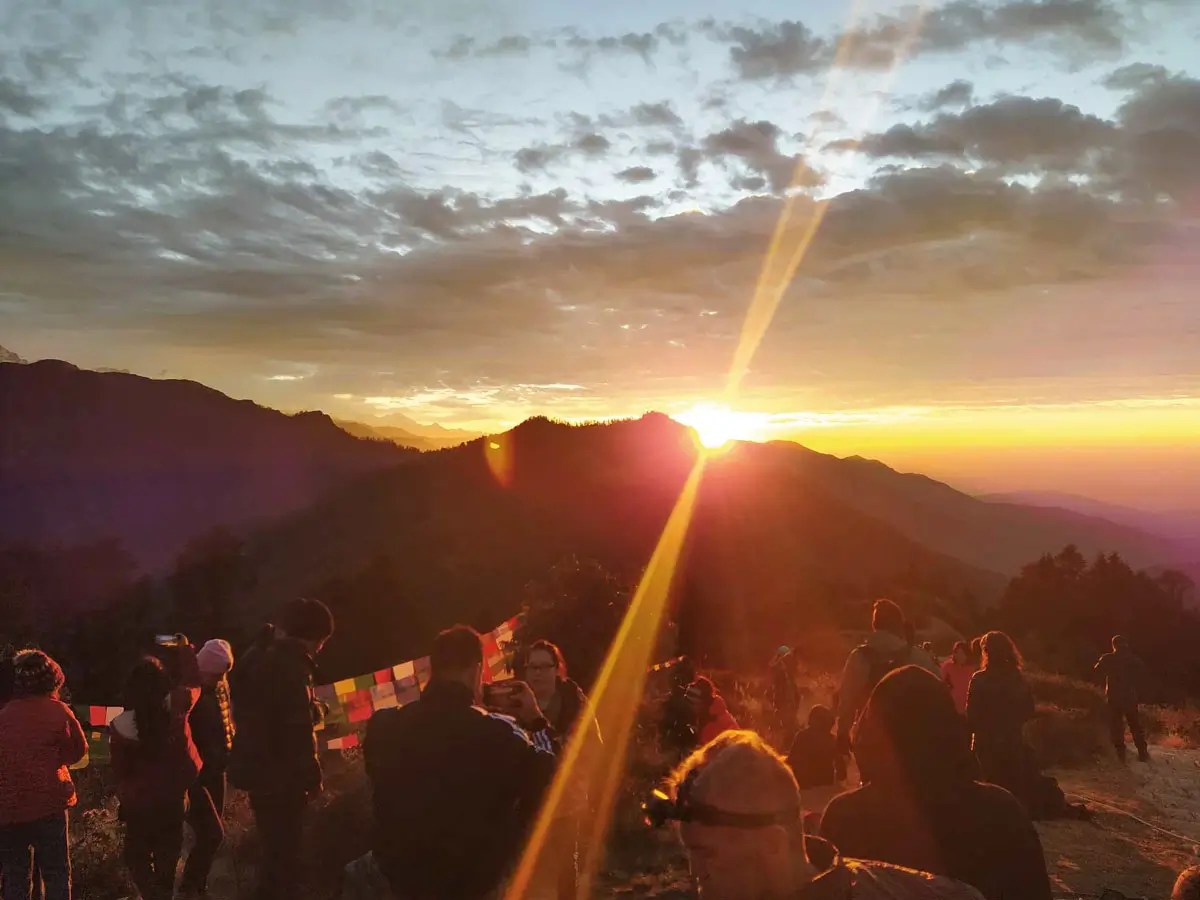
Sunrise view from Poon Hill!
How High Is Annapurna Base Camp?
Annapurna Base Camp sits at 4,130 meters (13,550 feet) above sea level, within a natural amphitheater formed by some of the Annapurna region’s highest mountains. It lies beneath Annapurna I, which rises to 8,091 meters, but reaching the base camp does not require mountaineering or technical climbing.
The final elevation matters because you can begin to experience altitude-related symptoms above about 2,500 meters, and altitude becomes increasingly relevant from Ghorepani onward, requiring closer attention after the trail enters the sanctuary.
What Does “Thin Air” at 4,130 Meters Really Mean?
People often say there is less oxygen in the air at Annapurna Base Camp. More precisely, oxygen still makes up approximately 21% of the atmosphere, just as it does at sea level. What changes is the atmospheric pressure.
As elevation increases, air pressure falls, and oxygen molecules become more widely dispersed. Each breath at ABC therefore delivers less oxygen to the lungs than the same breath would in Pokhara. At 4,130 meters, the available oxygen pressure is roughly 60% of its sea-level value, although weather and atmospheric conditions can cause small variations.
The body begins adapting by breathing faster and increasing heart rate, and trekkers may notice that climbing stone steps takes more effort, conversations shorten on steep sections, and their normal walking speed naturally slows. Sleep may also feel lighter or more interrupted during the first nights at higher elevations.
These responses do not automatically mean someone has altitude sickness. Feeling breathless during a steep climb is expected above Deurali. The bigger concern is a headache accompanied by nausea, dizziness, unusual fatigue, or reduced appetite.
The body already works harder to get oxygen, while low temperatures increase energy demands and may discourage you from eating or drinking enough. This combination can make an otherwise manageable day feel considerably more tiring.
Acclimatization allows the body to adjust gradually to lower oxygen pressure. It cannot make the air as rich as it is at sea level, but it improves how effectively the body uses the oxygen available. That is why walking slowly and allowing enough time are more valuable than trying to prove fitness by moving quickly.
What is the Altitude Profile of the Classic Annapurna Base Camp Route
The classic Annapurna Base Camp route does not climb continuously from the trailhead to ABC. It rises towards Ghorepani and Poon Hill, descends through Tadapani and Chhomrong, and then follows the Modi Khola valley into the Annapurna Sanctuary.
This changing profile gives trekkers several days of walking before they reach the route's highest point. Find the Altitude Profile of the classic Annapurna Base Camp Trek route in the table below.
Route location
Elevation
Importance in the altitude profile
Pokhara
830 m / 2,723 ft
Main gateway before the trek
Tikhedhunga
1,540 m / 5,052 ft
First trekking-night elevation
Ghorepani
2,860 m / 9,383 ft
First night close to 3,000 meters
Poon Hill
3,210 m / 10,531 ft
Early-morning viewpoint; not an overnight stop
Tadapani
Approx. 2,630 m / 8,629 ft
Lower sleeping elevation after Poon Hill
Chhomrong
2,170 m / 7,119 ft
Descent before entering the sanctuary
Deurali
Approx. 3,230 m / 10,597 ft
Trail enters a more exposed alpine environment
Machhapuchhre Base Camp
3,700 m / 12,139 ft
High-altitude point passed on the way to ABC
Annapurna Base Camp
4,130 m / 13,550 ft
High-altitude point passed on the way to ABC
Dovan
2,600 m / 8,530 ft
Considerable descent after leaving ABC
Jhinu Danda
1,760 m / 5,774 ft
Return to the warmer lower valley
The most important figure is not simply the difference between Himalaya and ABC. It is the change in sleeping elevation from Himalaya (2,920 meters) to Annapurna Base Camp (4,130 meters). Trekkers pass through Deurali and Machhapuchhre Base Camp during this stage, then continue upward to sleep at ABC.
Poon Hill provides earlier exposure above 3,000 meters, and the days through Tadapani and Chhomrong create a more measured approach than the shortest direct itinerary. Nevertheless, the body’s previous exposure does not guarantee protection. How a trekker feels during the final ascent should always take priority over reaching base camp according to schedule.
Elevations are approximate and can vary slightly between maps, lodge locations, and GPS readings.
Where Does Altitude Rise Most Quickly on ABC Trek
The most significant altitude gain occurs between the Himalaya and Annapurna Base Camp. The day begins at about 2,920 meters and reaches 4,130 meters, for a sleeping-elevation gain of about 1,210 meters. The trail first climbs past Hinku Cave to Deurali at approximately 3,230 meters and continues toward Machhapuchhre Base Camp at 3,700 meters, then gains another 430 meters before reaching ABC.
Section
Section
Himalaya to Deurali
310 m
Deurali to Machhapuchhre Base Camp
470 m
Machhapuchhre Base Camp to ABC
430 m
Total: Himalaya to ABC
1,210 m
This stage can feel demanding even though it covers only around 11 kilometers; the air pressure continues to fall, the terrain becomes more exposed, and the body has less time to adjust before sleeping above 4,000 meters.
Trekking to Annapurna Base Camp via Poon Hill provides useful exposure above 3,000 meters, helping you acclimatize. Start the upper stage slowly, take regular short breaks, and tell your guide immediately if you get a headache, nausea, dizziness, or unusual weakness.
Never treat the scheduled destination as more important than your condition; if symptoms develop or worsen, the guide may need to stop the ascent, allow more time, or arrange a descent, and this flexibility is a sign of responsible altitude management, not a failed itinerary.
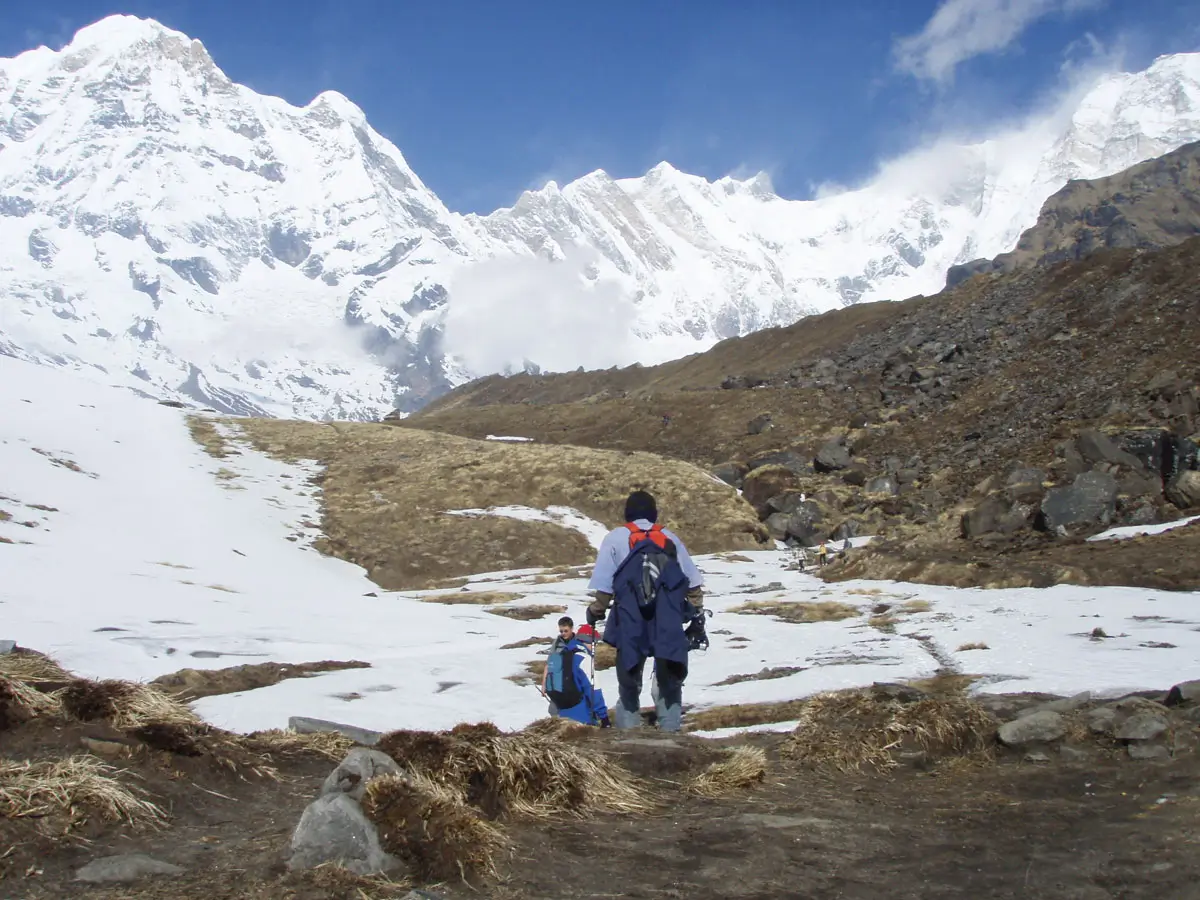
Our Clients walking towards ABC!
Can You Get Altitude Sickness on the ABC Trek?
Yes. Acute mountain sickness (AMS) can occur on the Annapurna Base Camp Trek because the route reaches 4,130 meters. Symptoms may develop after the body gains elevation faster than it can adapt to the lower oxygen pressure.
AMS often begins within several hours of arriving at a higher sleeping location, sometimes during or after the first night. This makes honest self-monitoring especially important around the Himalaya, Machhapuchhre Base Camp, and Annapurna Base Camp.
A common mistake is to assume that only unfit or inexperienced trekkers develop altitude sickness. In reality, fitness does not provide immunity. Strong walkers can increase their risk by climbing too quickly, ignoring early discomfort or trying to keep pace with faster group members. Previous success at altitude is encouraging, but it does not guarantee the same response on a future trek.
Outfitter Himalaya's classic ABC route approaches the sanctuary through Poon Hill, Tadapani and Chhomrong, giving trekkers several days of walking before the highest stage. This is more gradual than the shortest direct route, but it cannot remove altitude risk completely because the final sleeping-elevation gain remains substantial.
Heavy breathing during an uphill climb is expected and is not, by itself, proof of AMS. Concern grows when a headache develops after gaining altitude, along with nausea, dizziness, unusual fatigue, reduced appetite, or disturbed sleep.
Don't hide altitude sickness or treat it as a weakness. Reporting symptoms early gives the guide more options, while continuing higher in silence can turn a manageable problem into a serious one.
What Are the Early Symptoms of AMS?
Acute mountain sickness usually appears after a recent gain in elevation. A headache is the most characteristic early sign and is commonly accompanied by one or more of the following symptoms:
Nausea or vomiting
Loss of appetite
Dizziness or light-headedness
Unusual tiredness or weakness
Difficulty concentrating
A general feeling of being unwell
Disturbed sleep is common at higher elevations, but poor sleep alone does not confirm AMS. Likewise, a headache may result from dehydration, sun exposure, exhaustion, or another illness. Because symptoms can overlap, report any new headache or unexplained illness after ascending to the guide and have it assessed carefully.
Trekkers should watch for changes from their normal condition. Feeling slightly tired after a long climb is expected; becoming unusually weak, losing interest in food, or struggling to complete simple tasks deserves closer attention. Symptoms can appear during the walk, after reaching the lodge, or overnight.
Mild AMS often improves when the trekker stops ascending and allows the body time to adjust. Continuing higher while symptoms remain or become worse is unsafe. Painkillers may temporarily reduce a headache, but they should not be used to hide symptoms so the itinerary can continue unchanged.
The simplest rule is to communicate new symptoms early, after gaining altitude. This gives the guide time to monitor the situation, compare symptoms, and make a cautious decision before the condition progresses.
Which Symptoms Require Immediate Descent, and What Should You Do?
Mild AMS can often improve when the trekker stops ascending and rests at the same elevation. If symptoms become worse despite rest, however, descent is necessary. Serious altitude illness can progress quickly and should never be treated by simply waiting for morning.
Situation
Signs
Appropriate response
Possible mild AMS
Headache with nausea, dizziness, reduced appetite or unusual fatigue
Stop ascending, inform the guide, rest and monitor
Worsening AMS
Increasing headache, repeated vomiting or declining strength
Descend to a lower elevation
Possible HACE
Confusion, unusual behaviour, severe drowsiness or inability to walk in a straight line
Begin urgent assisted descent and arrange medical evacuation
Possible HAPE
Breathlessness at rest, chest tightness, worsening cough or rapidly reduced walking ability
Descend immediately and arrange emergency medical assistance
HACE, or high-altitude cerebral edema, affects the brain. HAPE, or high-altitude pulmonary edema, causes fluid to build up in the lungs, and both are medical emergencies.
A seriously unwell trekker should not descend alone. Use supplemental oxygen when available, but it should not delay evacuation to a lower elevation. Medication and portable pressure bags can support emergency treatment under trained supervision.
The most important field rule is simple: do not keep ascending if altitude symptoms worsen. Losing one trekking day matters far less than letting a preventable condition become dangerous.
Who Is More Vulnerable to Altitude Sickness, and How can You Acclimatize on the ABC trail?
Anyone can develop altitude sickness, but the strongest predictors are how high you sleep, how quickly you ascend, and how your body has responded to altitude before. The risk may increase when you follow a compressed itinerary, climb too aggressively, arrive already dehydrated or ill, or continue despite early symptoms.
Being young, strong or physically fit does not guarantee protection. In fact, fit trekkers sometimes move faster than their bodies can acclimatize. People with significant heart, lung, or other medical conditions should discuss the trek with a qualified doctor before traveling.
Acclimatization is the process through which the body gradually adapts to reduced oxygen pressure. It cannot be rushed, but the following habits support it. Our guide, Suraj, advises the following for your successful ABC trek.
Choose a gradual itinerary rather than the fastest possible ascent
Walk at a pace that allows comfortable breathing and conversation
Take short, regular breaks without allowing the body to become cold
Eat enough, even when altitude slightly reduces your appetite
Drink regularly, but do not force excessive amounts of water
Avoid alcohol while ascending
Sleep properly and report any new symptoms the following morning
Allow the itinerary to change if the body needs more time
Can a Pulse Oximeter or Diamox Prevent AMS?
A pulse oximeter and altitude medication can help, but neither replaces gradual ascent, symptom awareness, or descent when someone becomes seriously unwell.
A pulse oximeter estimates blood saturation and pulse rate. Readings normally drop with elevation, and different healthy trekkers may show different numbers at the same location.
Cold fingers, movement, poor circulation, nail polish, and device quality can affect the result. A single low reading therefore does not diagnose AMS, just as a reassuring reading does not prove that a symptomatic trekker is safe to continue.
The most useful approach is to consider oxygen readings alongside:
Current symptoms
Changes from earlier readings
Walking performance
Breathing at rest
The guide’s overall assessment
Symptoms and behavior should always take priority over chasing one “perfect” oxygen number.
Should You Take Diamox for the ABC Trek?
Acetazolamide, commonly known by the brand name Diamox, can help the body acclimatize and may be recommended for some high-altitude travelers. However, discuss it with a doctor who understands your health, medication history, and planned itinerary.
The medicine can cause side effects such as tingling sensations, increased urination and changes in taste. Do not borrow it from another trekker or take it without understanding how and when to use it.
Diamox does not make a rapid ascent automatically safe, and it must never be used to justify climbing higher with worsening symptoms. If serious altitude illness develops, descent remains the essential response.
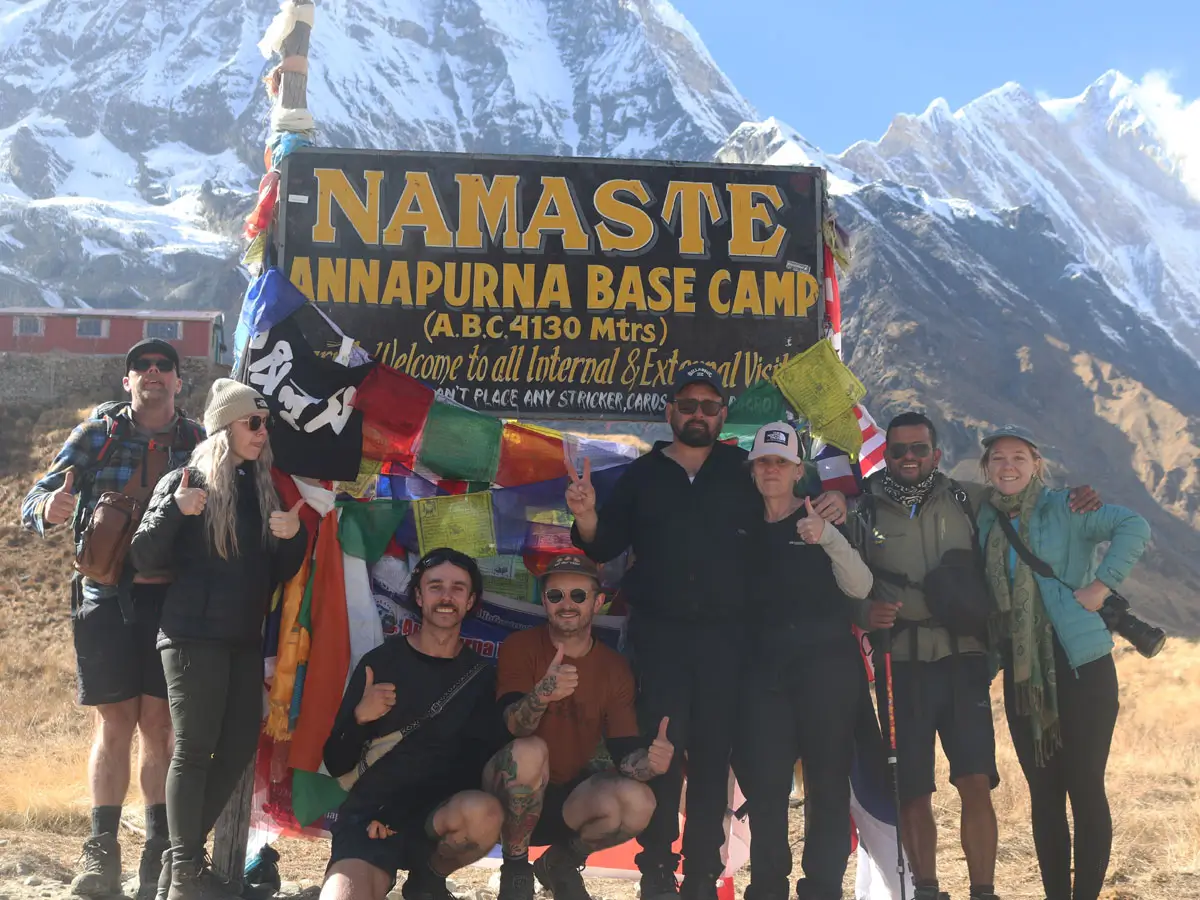
Our Trekkers reached ABC!
How Does ABC Itinerary Affect Altitude Exposure?
The number of days in an ABC package doesn't always reflect how gradually you gain altitude. Some itineraries include Kathmandu, Pokhara, and sightseeing days, while others count only the trekking section; overnight elevations and ascent speed matter more than the advertised package duration. Review our itineraries and choose the one that suits you best.
Provides a longer mountain experience but involves additional high-altitude walking and greater endurance
For most first-time high-altitude trekkers, the classic route offers a more measured introduction than the five-day direct itinerary. However, both the 14-day and 9-day packages follow a similar trekking progression; the difference in total duration mainly comes from the city and travel arrangements.
The helicopter-return option should not be mistaken for an easier ascent, and you still have to walk to 4,130 meters and spend the night at ABC before flying down. It saves several descending days and reduces strain on the knees, but normal altitude precautions remain necessary.
Travelers with previous altitude problems, medical concerns, or uncertainty about the pace should discuss itinerary customization before booking and add time before the highest sleeping elevation, as it helps acclimatization more than adding leisure days after the trek.
Practical Altitude-Safety Checklist and Tips from Outfitter Himalaya
What Should You Do Before and During the Trek
A few practical decisions can make altitude management much clearer:
Before Departure
Choose insurance that covers trekking above 4,130 meters and emergency helicopter evacuation.
Discuss the journey with a doctor if you have a medical condition, take regular medication, or have previously experienced severe altitude illness.
Learn the difference between normal exertion and symptoms that appear after gaining elevation.
Select an itinerary based on your altitude experience, not only the number of available days.
On the Trail
Walk slowly and avoid competing with other trekkers.
Eat regularly and drink enough to remain normally hydrated.
Tell the guide about symptoms as soon as they appear.
Check how you feel after arriving and again the following morning.
Do not ascend while AMS symptoms are becoming worse.
Watch other group members for confusion, poor coordination or unusual behavior.
Never allow a seriously unwell person to descend alone.
Travel insurance, a first-aid kit and a pulse oximeter are useful safeguards, but the most valuable tools remain time, communication and a willingness to descend.
Conclusion: Respect the Altitude, Not Fear It
The Annapurna Base Camp Trek reaches a serious but manageable elevation of 4,130 meters. The changing air becomes most noticeable inside the sanctuary, particularly during the final ascent from Himalaya through Deurali and Machhapuchhre Base Camp.
Altitude sickness is not a test of courage or fitness. Stopping, resting, or descending when necessary is responsible mountain travel. With realistic preparation, an experienced guide, and respect for the body’s pace, you can enter the Annapurna Sanctuary confidently and appreciate the extraordinary landscape surrounding ABC.
This guide provides general travel information and does not replace personalized medical advice. Travelers with health concerns or a history of severe altitude illness should consult a qualified medical professional before trekking.
The Annapurna Circuit Trek covers approximately 102 kilometers of walking on Outfitter Himalaya’s classic 15-day itinerary, including the Manang acclimatization hike. The journey unfolds through riverside forests, mountain villages and open valleys before crossing Thorong La [...]
The Annapurna Circuit Trek costs about USD 650–1,900 per person with Outfitter Himalaya, depending on the itinerary, group size, and services included. Outfitter Himalaya’s 15-day Classic Annapurna Circuit Trek has published group-size prices of USD [...]
Foreign trekkers need a trekking permit to trek the Annapurna Circuit, and we suggest settling it before you head out. Arranging the correct paperwork before departure helps avoid extra charges and interruptions once your journey [...]